

Search in progress...

mai 2026
CHARLOTTE RIGAL – Paper lace maker
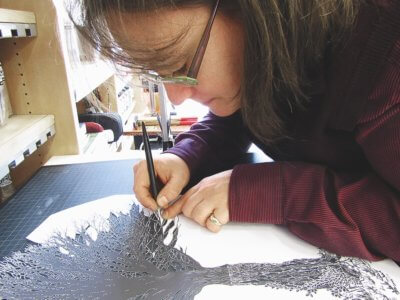
A small table, a pencil, a cutter and a sheet of paper.
That’s just about all you need to know about paper-cutting. And that’s just about all, because you also need concentration, dexterity of gesture, a good sense of proportion, unparalleled precision and the ability not to worry about the passage of time. Needless to say, the art of paper-cutting is not for everyone. Originally from France, Charlotte Rigal took up the art of paper-cutting 10 years ago by chance. It was love at first sight. To immerse herself in the culture of paper-cutting, she compiled art books and various documents tracing the history of this art form practised in the early 19th

All these symbols from Swiss history were not at all part of my culture,” says Charlotte Rigal. But when I started practicing, I immediately fell in love with the meticulousness of the technique and the sense of detail it implies. The finer the drawing, the greater the challenge. To hone her skills, her very first works were inspired by traditional cut-outs, respecting and continuing the values they convey. As time went by, the artist took liberties with tradition, since classic cut-outs offer neither perspective nor depth. Nor do they reproduce shadows. While she still makes traditional cut-outs to order, Charlotte Rigal now builds her own landscapes – often rural scenes – which she draws with expert precision and cuts with equal virtuosity.
Under the sharp edge of her cutter, breathtaking paper feathers, lacy corals and wildly light cursive lettering come to life. Farms, too, as well as forests and cottages, all in texture and perspective. These realistic paintings, whose aesthetic evokes lithography, are enchanting and impressive for their lace-like finesse.
IN FIGURES
19 – In Switzerland, the practice of paper decoupage began in the 19thcentury in the Château-d’OEx region, under the impetus of Johann Jakob Hauswirth and then Louis Saugy.
2008 – The year of Charlotte Rigal’s very first cut-outs.
80 – The weight of two-sided paper generally used by die-cutters.
100 – The number of cut-outs produced each year by the artist.
DECOUPAGE STEP BY STEP
Step 1: arm yourself with patience, a sheet of two-tone paper – black on one side, white on the other – a pencil and a pair of small, sharp-tipped scissors or a cutter.
Step 2: fold the sheet of paper in half, keeping the black side on the inside and the white side on the outside.
Step 3: trace the desired design onto a blank side or print the chosen motif. The use of a tracing paper can also be a good pre-cutting option.
Step 4: Everything’s ready, and cutting can begin, starting with the central part. The aim is to keep the cut paper in one piece, without gluing.
Step 5: unfold the meticulously cut sheet of paper to reveal the symmetrical pattern or design. If the result isn’t what you’d hoped for, for more advice, classes or special orders, visit www.atelierlalinea.net