Search in progress...
mai 2026
From the wood of which the notes are made
Officially, she is a “Master Violin Maker”. But Esther Bornand prefers to be called a “luthière”, a word that has only just begun to be feminized, since lutherie has long been the preserve of men.

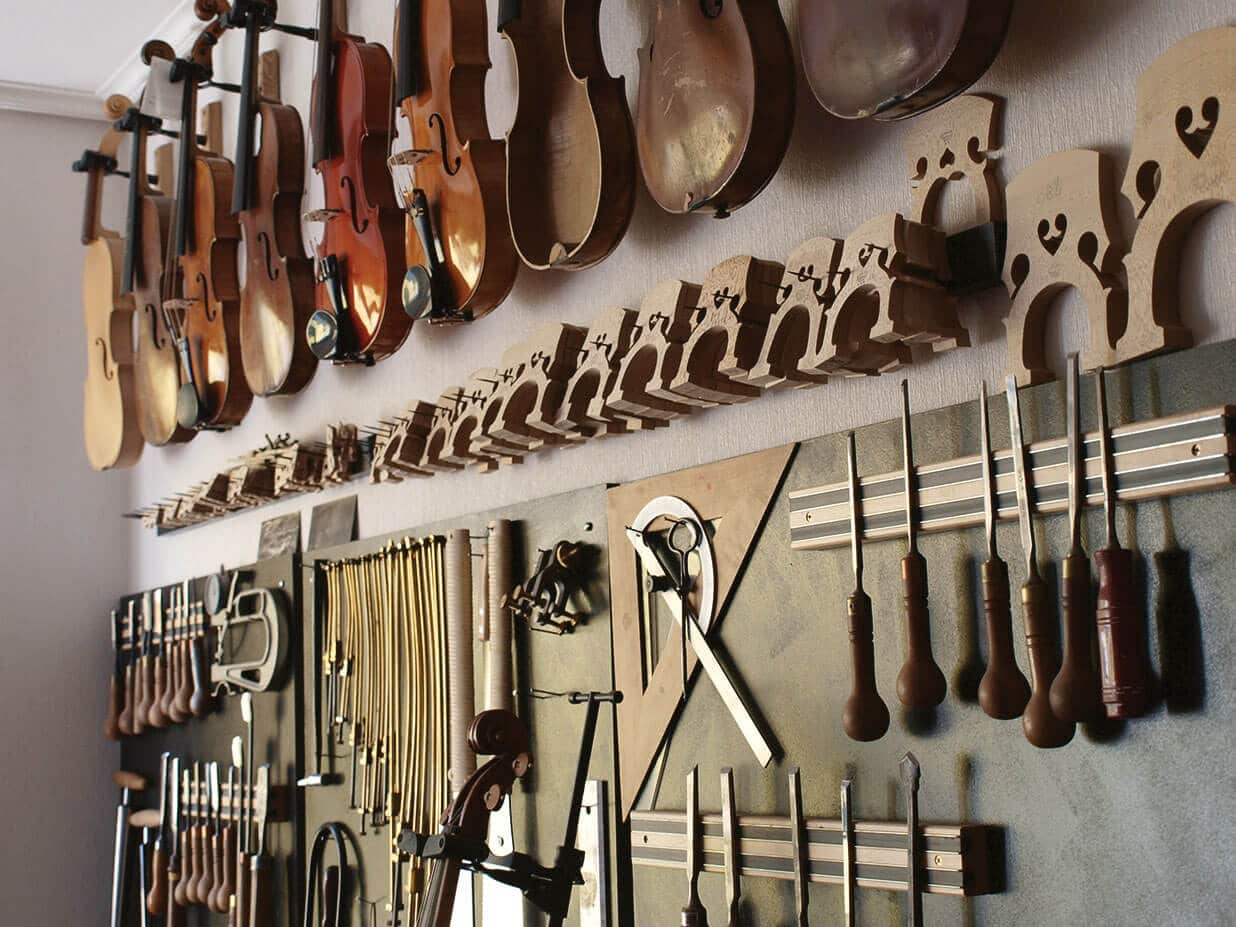
This craftswoman was also the first Swiss woman to practise this profession, having obtained her CFC in 1997, supplemented by a Federal Master’s degree in 2002. In Lausanne, her address has been known for 12 years to classical quartet musicians, who call on her expertise to maintain or restore their instruments. In his workshop, the precision of the artisan’s gesture sets the tone for giving a new lease of life to the violins, violas and cellos entrusted to him.
For Esther, music is where it all began. A violinist from the age of 7, she turned to an apprenticeship in violin making after gymnasium. It seemed more sensible to learn how to build a violin than to play at the level I aspired to,” she smiles. Besides, being on stage wasn’t very obvious to me”. It was behind the scenes that she found her calling, while continuing to play the violin in her spare time. Not all luthiers are musicians, but for me it’s essential,” she explains. It gives me a good understanding of what musicians want. Before any maintenance or restoration work, we have to be in tune with each other.

On a daily basis, Esther works on several instruments at once. Using special tools – tooling, penknife, core point, gouge – she renovates and repairs, carves, planes and glues each element with “patience and a keen eye for detail”. On a violin, she will replace the bridge, the piece of maple that supports the strings, or check the core of the instrument, the small spruce cylinder hidden inside the violin but essential for sound transmission. On this viola, the fingerboard worn by the musician’s fingers needs to be planed. On this cello, it’s a simple matter of cleaning, perhaps applying a new varnish to the top, back, sides, neck and scroll headstock. A rejuvenating treatment for “these instruments that live and evolve with time”, and whose life the luthier takes infinite pleasure in prolonging. For the beauty of gesture and music.

IN FIGURES
2
Spruce and maple are the two types of wood used to make a violin.
10
The minimum number of years of drying for the wood of a future violin
71
The number of parts that make up a violin
200
The number of hours needed to create a violin
3160
In hertz, the maximum pitch of a violin
1550
The birth year of the first violins

LEXICON
HARMONY TABLE
This is the piece of spruce that forms the top of the violin. It is the part of the instrument that vibrates the most, like the skin of a drum. Depending on the thickness and arch of this piece, the instrument will resonate differently.
CHEVALET
This piece of maple, fitted to the top of the violin, supports the instrument’s 4 strings and is held in place only by pressure.
SOUND
This small spruce cylinder is wedged between the soundboards and serves both to transmit sound and to support string pressure.
OUÏES OU FF
These two symmetrical openings on the face of the violin soundboard allow air to escape from the body of the instrument.
ANTONIO STRADIVARIUS
He is certainly the world’s most esteemed and best-known luthier. His violins are colloquially known as “Strad”.
VOLUTE
This term refers to the spiral-shaped headstock. It is the only part whose shape can be modified without altering the sound of the violin.