
Search in progress...

mai 2026
RACE FOR WATER An odyssey to preserve the oceans
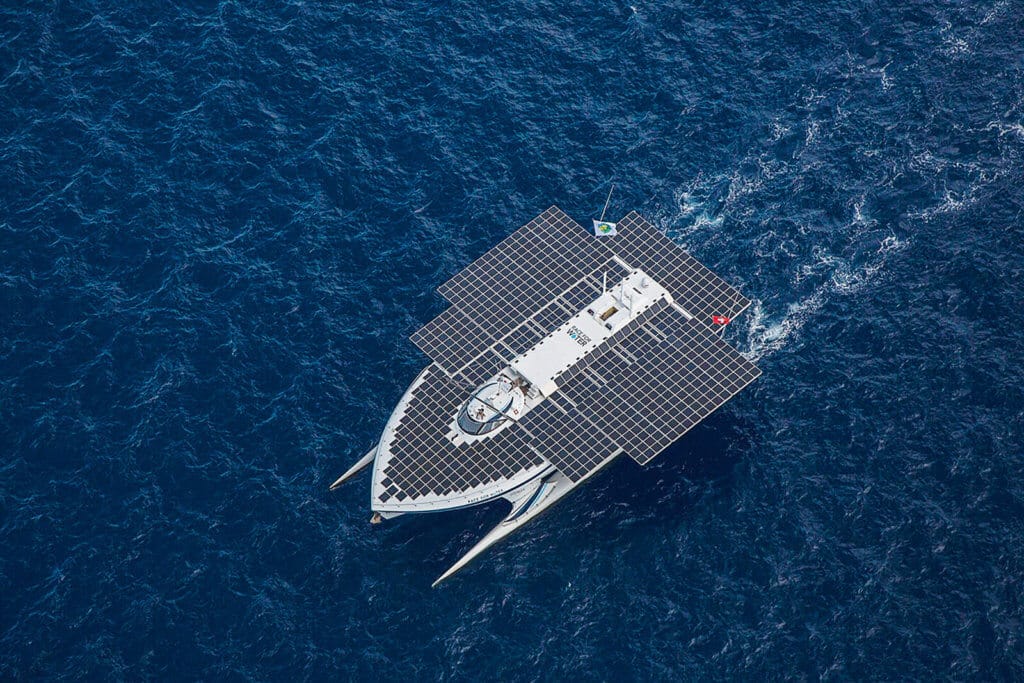
Plastic islands” do not exist. That’s the conclusion reached by the scientists on board in 2015 during the first Odyssey of the Race For Water Foundation. Plastics don’t pile up in the oceans. Their mass is in fact far more pernicious, since this pollution is made up of billions of uncontrollable, impossible-to-collect plastic microparticles. Faced with this frightening fact, after years of working on concrete solutions to recycle wild plastic waste, Race for Water set sail again in 2017 for a round-the-world Odyssey to meet political players and populations. “This new expedition demonstrates the existence of concrete solutions for preserving the oceans,” emphasizes Marco Simeoni, President of the Race for Water Foundation. On the one hand, we are demonstrating that if we act on land, it is possible to curb plastic pollution of the oceans, notably by integrating a technology capable of transforming plastic waste into a marketable energy resource. In this way, we are creating a value chain for untreated plastic waste with sustainable environmental, economic and social impacts. On the other hand, we are accelerating the energy transition by showing that a vessel with mixed solar-hydrogenkite propulsion is capable of completing a 5-year expedition around the world.”
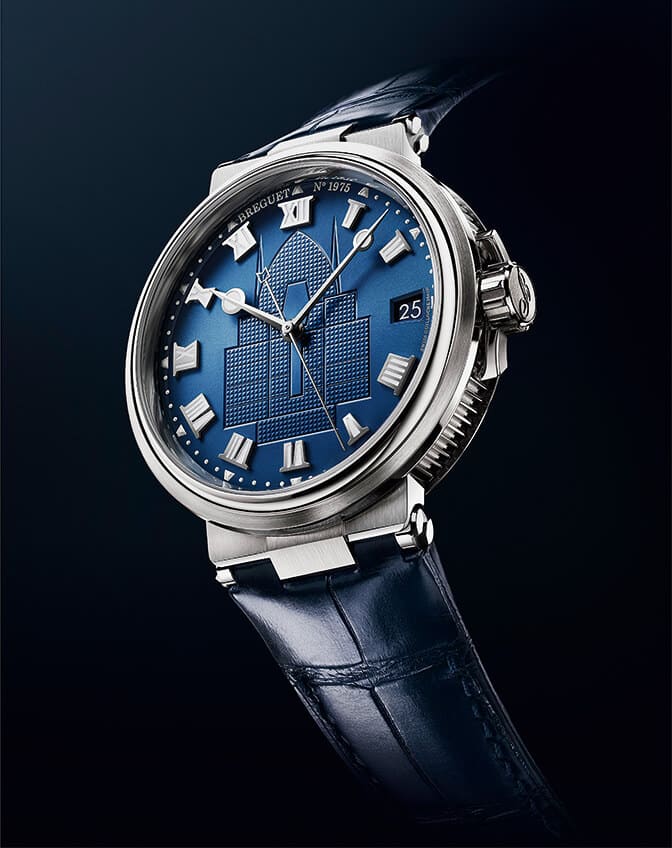
Breguet is celebrating its partnership with Race for Water by unveiling a special edition of its Marine 5517 model in a titanium case with a blue dial decorated with the boat’s hand-engraved silhouette.
The House of Breguet naturally joined this crazy project as the main partner. For Montres Breguet President Marc A. Hayek, this was an obvious choice: “Our company creates mechanical timepieces designed to span generations. We are accustomed to taking a long-term view, and are committed to preserving the heritage we pass on to our children. They are the future of our planet, and it’s up to all of us to preserve the precious and vital resource of water. A major challenge for a long-term adventure to be followed until 2021 on www.raceforwater.com.
In figures
80 80% of marine litter is plastic.
20 Plastics production has increased 20-fold in the last 50 years.
1 The equivalent of a truckload of plastic waste is dumped into the oceans every minute.
622 It is estimated that 622 million tonnes of plastics will be produced by 2030.
2050 A study by McKinsey and the Ellen MacArthur Foundation predicts that, if current production patterns continue, the oceans will contain more plastic than fish (by weight) by 2050.
A MODEL FOR ENERGY TRANSITION
Because plastic is not the only pollution to which the oceans are exposed, the Race for Water Foundation has chosen for its new Odyssey a boat powered solely by a mix of three clean energies. Firstly, solar power, with 512m2 of solar panels producing energy stored in eight tons of lithium-ion batteries on board. Then wind, with a 40m2 self-piloting kite deployed at an altitude of 150m. Finally, 200kg of hydrogen are stored in 25 cylinders at 350 bars and converted into electricity using two fuel cells. A real technological feat, designed to demonstrate the power of renewable energies and accelerate the search for new concrete solutions for sustainable development.