
Search in progress...
mai 2026
Swiss Camera Museum – The curious machines of the 8th art
From the invention of photography 175 years ago to the present day, the museum tells the story of the formidable technological (r)evolution behind the 8th art. Push the door, the entrance is on the Grande Place…
In the age of Instagram and the selfie craze, the Swiss Museum of the Photographic Camera tells stories that are often unfamiliar to those under twenty: those of photography and the incredible technical inventions that have marked the epic of this art of creating images. Long before photography became as simple as the click of a button, it was the work of ingenious machines that we now observe with a keen eye.
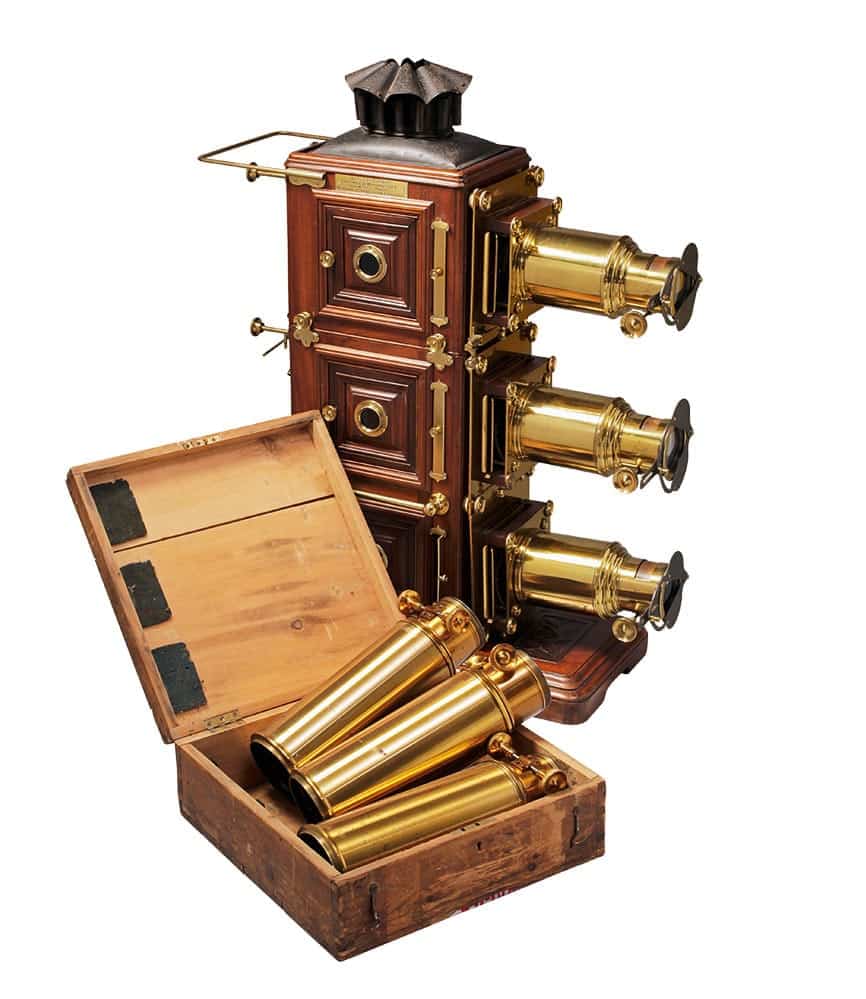
Triple projection lantern made circa 1895 by William Charles Hughes, London In mahogany and brass, this two-part lantern, which can also be used as a double lantern, still possesses its original hydrocarbon lighting system.
In the museum’s exhibition rooms, you can enter the very heart of a camera obscura, experiment with the use of the silhouette drawing machine, come across illustrious names such as Niépce or Daguerre, and discover surprising devices such as the Telephot or the Melanochromoscope. But the Musée de l’Appareil photographique, which you can visit chronologically, refuses to tell the story in a dusty way, to show the camera as an obsolete object.
The directors and curators, Pascale and Jean-Marc Bonnard Yersin, have always endeavored to anchor the museum in its time. The digital revolution is also present in this museum, whose collection of 15,000 objects and two annual temporary exhibitions keep visitors coming back for more.
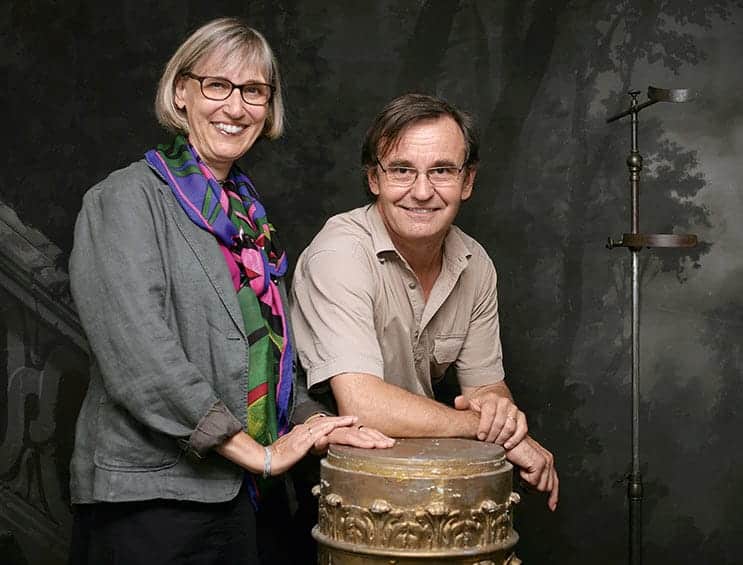
Three questions for Pascale Bonnard Yersin, Director and Curator
What is the museum’s vocation?
It is the only institution in Switzerland dealing with photographic material in the broadest sense. The museum not only has a collection of cameras, but also a whole range of objects related to silver image processing – enlargers, films, products, plates… from the origins of photography to the present day. Its vocation is to preserve these numerous objects and all related documentation.
How has the museum responded to the digital revolution?
We realized that not everyone understood what a film was. For younger people, it’s something very abstract. So we had to talk to the public in a different way, showing other objects. In 2010, we put together a new exhibition called “Digital Revolution”. As the museum is chronological, you can start or finish with this section. It’s very important for young people to be aware of everything we had to go through to get to where we are today.
The museum celebrates its 35th anniversary. How do you see the next 35 years?
That’s a big question, because my husband and I are only here for another four years. We will have helped to give new impetus to this fine heritage, and our aim today is to hand over the keys of the institution to our successor in the best possible way. Perhaps he’ll give it a different, more image-oriented direction, like the Musée Nicéphore Niépce in Chalon-sur-Saône…
Swiss Camera Museum
Grande Place 99
1800 Vevey
021 925 34 80
www.cameramuseum.ch