
Search in progress...
mai 2026
The Meylan watchmakers
The watchmaking towns of the Vaud region – Nyon, Rolle, Morges, Lausanne, Vevey and Moudon – employ around a hundred workers who make ébauches for the metropolis of Geneva. It wasn’t until 1723, when the Bernese granted each watchmaking town a master’s degree, that the Vaudois were able to call themselves watchmakers. This master’s degree regulated the profession very strictly and guaranteed corporation members a monopoly on their art; watchmakers soon formed a veritable aristocracy. The first combier watchmakers appeared in the early 18th century. These are some of the most talented iron craftsmen – cutlers, gunsmiths, etc. – who make crude Franc-Comtois-style weight clocks. – some of the most talented iron craftsmen in the world, who made crude Franc-Comtois-style weight clocks. The initiators were the Golays; Moïse and Isaac built the clock for the Sentier temple in 1737. Samuel-Olivier Meylan, son of Jean-Baptiste, a resident of Chez-le-Maître, was the first watchmaker in the Vallée de Joux. He probably came from a family of blacksmiths.
Becoming a watchmaker is no mean feat. According to the master’s regulations, you had to complete a five-year apprenticeship with a master, work for three years as a craftsman, and finally present a watch built entirely by your own hands, the masterpiece, on the basis of which a jury would decide whether to award you the watchmaker’s patent, which alone gave you the right to have an apprentice or a craftsman.
However, he was indicted by the Rolle master craftsman’s guild and had to regularize his status; he didn’t officially become a watchmaker until 1748, when the Moudon master craftsman’s guild accepted his masterpiece, which he had made in the Principality of Neuchâtel.
The absence of a guild in the Vallée was a major handicap for the would-be watchmaker, in that he was obliged to spend eight years abroad to acquire his title, and to bear the considerable cost of his upkeep. At Samuel-Olivier’s request, LL. EE. released, on February 5, 1749, the Combiers from their obligations towards the maîtres until they were numerous enough (seven maîtres) to form one in Le Chenit. A year after Samuel-Olivier’s death, in 1756, the Bernese government granted a watchmaking master’s degree to Le Chenit.
These master’s degrees had two aims. On the one hand, they were to guarantee the quality of watchmaking, which they were never able to do, and, on the other hand, to benefit the country and them (the watchmakers) in particular (Maîtrise de Rolle, 1723), which on the other hand succeeded perfectly insofar as the masters rapidly grew rich. The watchmaker, on the other hand, barely made a living from his many hours of work, and derived no benefit from these regulations, which served only to stifle isolated industrial endeavors and impede progress (Marcel Piguet, op. cit.). Faced with protests from Morges, Lausanne, Rolle and the Valley, LL. EE. abolished the master’s degree system in 1776. By this date, there were eight Meylan watchmakers in La Vallée. They all came from the end of the lake.
The abolition of master craftsmen’s guilds, removing the obligation for watchmakers to build a complete watch, ushered in the era of the division of labor, which was to turn the lives of Combiers upside down. Small, family-run businesses sprang up, specializing in one part of the watchmaking process. Finished watches were no longer produced, making access to the profession much easier. Although the division of labor implied a certain deskilling and less interesting work (repetition of the same gestures), it rationalized it, increased production capacity, lowered manufacturing costs and heralded the industrial production of mass-produced watches. The Combiers practiced it to such an extent that by the end of the 19th century, there were over fifty watchmaking companies in the Vallée, a minority of which produced finished watches. The period of scarcity was over, and the watch brought by Samuel-Olivier enabled the future Vallée district to achieve unhoped-for prosperity.
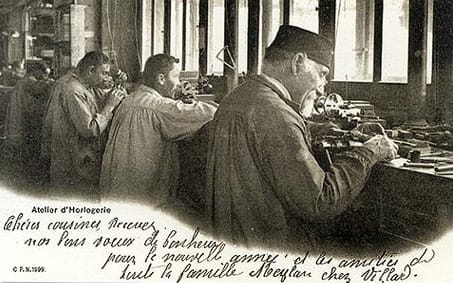
There was no shortage of remarkable watchmakers during the two and a half centuries of the Combiere watchmaking tradition. Not all were Meylans, of course, but the most outstanding early 19th-century watchmaker was Philippe-Samuel Meylan.
Philippe-Samuel was born in Le Brassus on February 15, 1772, and died in Geneva on April 3, 1845. His father, Henri, was said to be a locksmith of genius (secret locks), and Philippe-Samuel was even more brilliant in his field.
His domain, in fact, encompasses everything to do with precision mechanics: his watches are one-of-a-kind, and his automata are no match for those of the great Jaquet Droz. The automaton that constitutes his masterpiece is a marvelous grotto from which a monk emerges, strikes the rock and answers in writing one of twenty-eight choice questions, deposited by the spectator in a drawer (Marcel Piguet, op. cit.). He built white mice that ran, stopped and ran again, ending their run with a jump or a swerve (id.). He made pistols that contained a watch in the butt, and whose trigger let out a songbird from the barrel. The almost complete collection of his automata was bought by an Australian; the boat was wrecked and the marvellous works it contained lay at the bottom of the Indian Ocean.
He made extra-flat watches called “montres-monnaies”, and succeeded in inserting the mechanism of a watch into an old twenty-franc coin. This tour de force was made possible by his “bagnolet” invention, which reversed the movement layout.
He produced a large number of skeleton-watches, i.e. watches with two visible plates engraved with designs of flowers and intertwined plants; the mechanism is also visible, and the pivots turn at the center of the flowers or at the intersection of the stems.
He was the first to equip watches with sounding blades and the mechanism to make them vibrate, and it was he who invented the alarm ring, a ring fitted with a tiny watch whose mechanism makes a steel point penetrate the finger at the desired time.
In 1811, together with Isaac Piguet, he founded the Piguet et Meylan firm in Geneva, which was one of the most important in the city until 1828, when the partners separated. Earlier, in Le Brassus, he had worked with another Piguet, Charles-Auguste. It was he who trained Louis Audemars and enabled him to settle in La Vallée; it was from Louis’ family that Audemars, Piguet & Cie was born, which today is the world’s most renowned prestige watch manufacturer.
In Geneva, Piguet et Meylan specialized in luxury automaton and music watches, decorated in the “Genevoise” style; the two partners were masters of the genre and produced Chinese watches, most of which were gold, enamelled and pearl-set pieces destined for Chinese export.
His son, François (1800-1882), continued his father’s work, while his
second son, Hector, tried his hand at painting. After two generations of stockbrokers, Philippe-Samuel’s family is still present in Geneva through the fourth generation, represented by Yvonne, born in 1913, through the fifth, represented by Jacques, born in 1929, a gynecologist like his father (René, 1902-1968), and through the sixth, formed by Jacques’ three children.
Although Philippe-Samuel’s descendants have abandoned their ancestor’s profession, there are still a few watchmakers in French-speaking Switzerland with the Meylan name to bear witness to their ancestors’ work.