Search in progress...

mai 2026
Watchmaking innovation: a question of materials
If watchmakers are to be believed, the Olympic motto “Citius, Altius, Fortius” has become the daily leitmotif of today’s
generations. In a word, the sport watch is everywhere and adapts to every circumstance. In this context, while models designed for everyday adventure are still readily adorned with precious metals such as gold and platinum, there is no longer any question of fashioning them solely from traditional alloys. As for those designed to withstand everything, even the most extreme conditions, they now call on materials designed for aerospace or Formula 1 racing, as robust as they are light, as resistant as they are unalterable.

At first glance, one might wonder what a timepiece would gain by integrating components developed for the combustion chamber of a racing car turning at 350km/h on a racetrack. Since engineers have invaded the R&D departments of watchmaking companies, the answer to this question has first and foremost concerned the “engines” of wristwatches. Questions of friction, wear, point of inertia, lubrication, lightness and magnetism have all been answered by these materials of the future. Gradually, the field of application was extended to cover components such as crystals, cases and bracelets.
Watchmaking grail
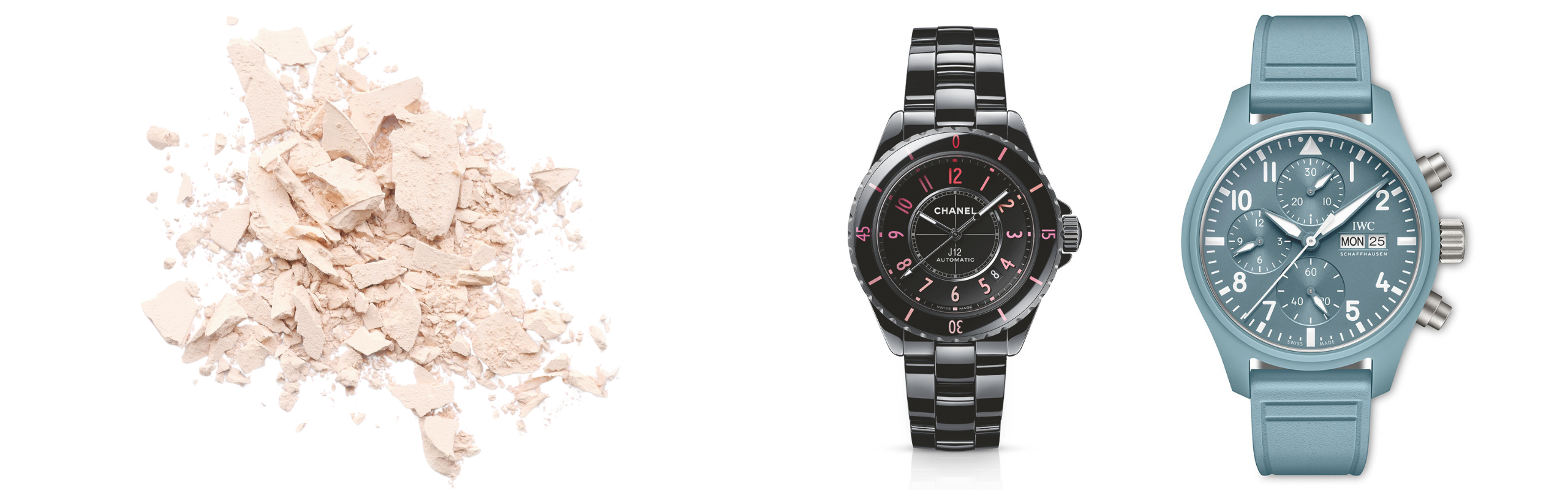
Where silicon began to work wonders for the regulating components of mechanical calibres, ceramic and carbon have taken over for watch cases. The former for its exceptional hardness, hypoallergenic properties and adaptability to industrial processes enabling, for example, the growth of gold inlays on a ceramic bezel, as in the case of Omega’s Ceragold. Or to rigidify a precious metal such as gold, as with the scratch-resistant Magic Gold developed by Hublot with the Ecole Polytechnique Fédérale de Lausanne. Or to reinforce the temperament of a collection, as in the case of Chanel, whose J12 models are intimately linked to ceramics.

Carbon has generated the same fever among watchmakers, thanks to its lightness and exceptional resistance. The Zenith Defy Classic 41mm, water-resistant to 100m, is clothed in carbon from bracelet to case, weighing just 65 grams! But watchmakers were obviously not content with these “simple” recipes. Alloys began to proliferate, such as Zenith’s ceramized aluminum, Omega’s tungsten carbide and Liquidmetal (metallic glass made from zirconium, titanium, copper, nickel and beryllium), Hublot’s Hublonium (aluminum and magnesium) and IWC’s Ceratanium (titanium and ceramic). These few examples, all of which required months if not years of development, demonstrate that watchmaking technology is not everything. Today, the complexity of mechanisms is matched by materials engineering. A science that is now incorporating new approaches to sustainable development, as evidenced by bracelets made from vegetable “leather”, cases made from recycled materials and solar-powered movements.

GREEN TIDAL WAVE
New materials are not just about high-tech alloys. Now that sustainable development has entered the corporate world, watchmakers have begun to develop forward-looking solutions in this field. Such is the case of Ulysse Nardin, which presented a concept watch, the Diver Net, whose case and bezel are made from a material created from discarded fishing nets transformed into polyamide granules. The crystal is made from transparent ceramic with the lowest environmental coefficient, and the bracelet is made from a textile made from 100% PET recovered from the sea. The start of a tidal wave?